
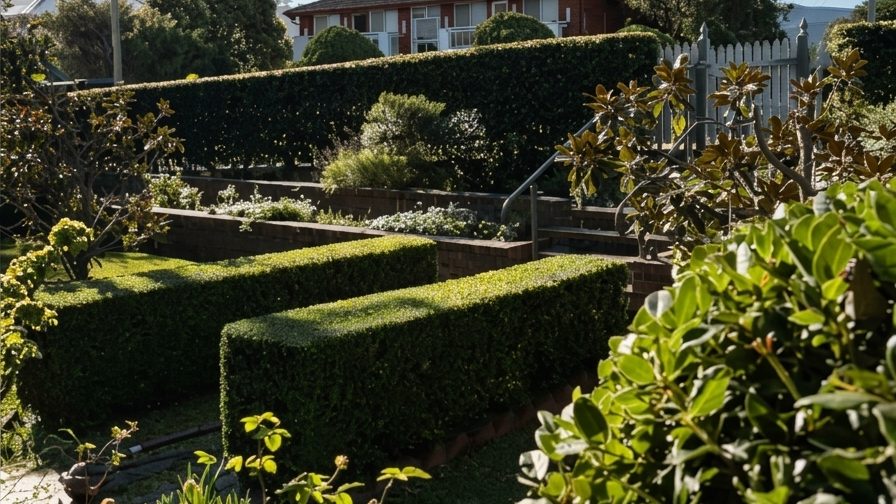
If the new leaves on your lilly pilly hedge are covered in small raised bumps, you have psyllids. On the humid NSW coast they are the main reason a lilly pilly hedge looks tired, and the fix starts at the nursery, well before the first clip.
The short answer
Buy a psyllid-resistant variety. For hedges and screens we plant Syzygium ‘Resilience’, ‘Straight & Narrow’ and Syzygium australe ‘Select’. For a clipped privacy hedge, plant 60 to 80cm apart. Prune lightly and often through the growing season so the hedge never gets leggy, and feed it a slow-release native fertiliser in spring and autumn.
Why we like it for hedging
Lilly pillies (the genera Syzygium and Acmena) grow quickly and have the dense, upright habit a hedge or topiary needs. They handle regular pruning and will also take a hard prune. Leave one unclipped and it flowers in creamy clusters, then sets edible fruit that brings birds into the garden.
What causes the bumps
The lilly pilly psyllid is a sap-sucking insect a few millimetres long. It lays eggs on soft growing tips. The young feed on the expanding leaves, and the leaf grows a pimple or pit around each one. That is the lumpy, distorted foliage you see from the street.
Psyllids can only feed on soft new growth. Once a leaf hardens off it is safe, which is why the damage shows up in flushes and is worst from late spring through summer, when hedges are pushing the most new growth.
The best lilly pilly for a hedge
Resistance is a matter of degree. Growers describe the best varieties as highly resistant, not immune, and a stressed plant under heavy pest pressure can still show damage. Starting with a resistant variety still makes the biggest difference of anything on this page.
| Lilly pilly | Psyllid | For a hedge |
|---|---|---|
| Syzygium australe ‘Resilience’ | Highly resistant | One of the most widely planted hedging lilly pillies in NSW |
| Syzygium smithii (Acmena) selections | Highly resistant | Several compact forms bred for hedging |
| Syzygium luehmannii (riberry) | Resistant | Small leaves, fine texture |
| Syzygium paniculatum types, including ‘Lillyput’ | Susceptible | Avoid for a hedge on the coast |
| Waterhousea floribunda (weeping lilly pilly) | Susceptible | Better as a tall screen or feature tree |
There is a local twist. The magenta lilly pilly, Syzygium paniculatum, grows naturally along the NSW coast between Taree and Sussex Inlet and is listed as threatened in the wild. It is also one of the lilly pillies psyllids hit hardest. Syzygium smithii grows naturally in east coast rainforest from Queensland to Victoria and sits among the most resistant.
The three we plant
For screening and hedging we use Syzygium ‘Resilience’, Syzygium ‘Straight & Narrow’ and Syzygium australe ‘Select’. Newer cultivars are generally less prone to psyllid, and ‘Resilience’ is the one that doesn’t get it in our experience. ‘Straight & Narrow’ is sold as Syzygium australe ‘SAN01’. Its breeder, Ozbreed, lists natural psyllid resistance and a slim habit for tight spots along fences and driveways, but rates it as not for coastal gardens.
Check the label against your aspect before you buy. Varieties range from full sun to part shade, so the right choice for a north-facing front fence may not suit a shaded side boundary.
How far apart to plant
Spacing decides how quickly a hedge closes up, and it is hard to fix later. Common spacings:
- 50 to 60cm for a dense, formal hedge, such as along a pool fence or a front boundary.
- 60 to 80cm for a clipped privacy hedge. This suits most hedging varieties.
- 1 to 1.5 metres for a looser, informal screen that you trim less often.
Plant too far apart and the gaps between plants can stay open for years, because each plant grows up faster than it grows sideways into its neighbour.
When to prune a lilly pilly hedge
Little and often beats one hard cut a year. Take the soft tips off after each flush of growth and the plant branches from just below every cut, which is what builds a dense face. Skip it and a lilly pilly gets leggy: it stretches upward and gaps open up in the foliage. They take a hard prune well, so a hedge that has got away from you can be cut back, though it will look thin for a season while it recovers.
Pruning and psyllids are linked. Clipping removes the soft, infested tips, but every cut also triggers a new flush of the soft growth psyllids feed on. On a resistant variety that barely matters. On a susceptible one it can turn summer into a cycle of trim, flush, damage, which is the strongest argument for choosing the right plant at the start.
Our planting calendar puts the main hedge trim in November, when growth is quick enough for a clipped hedge to fill back in before Christmas.
Soil and feeding
Lilly pillies prefer well-drained soil, so avoid planting a hedge where water sits after rain. Feed with a slow-release native fertiliser in spring and again in autumn for the best growth. If your garden sits on heavy escarpment clay, our note on escarpment and coastal gardens covers what that soil means for planting.
If your hedge is already covered in bumps
A healthy plant copes better, so start with watering through dry spells and a layer of mulch over the root zone. Some growers spray horticultural oil as the first spring flush appears to cut psyllid numbers. On a hedge of a susceptible variety that has struggled for years, replacing it with a resistant one can end up cheaper than treating it every summer.
We’d like to walk the property with you.
Free on-site consultation across the Illawarra. We’ll look at the hedge you have, or the boundary you want screened, and recommend the variety, spacing and upkeep in writing.